Local Area Networks (LANs) use one of the following physical layout designs. These designs are referred to as 'topologies'.
| Topology | Types |
|---|---|
| Bus | (Logical Ethernet) |
| Hub and Spoke (Star) | (Physical Ethernet) |
| Hybrid (Bus & Star) | Ethernet |
| Point To Point / Daisy Chaining | Serial |
| Point to Multipoint | Frame Relay |
| Ring | FDDI, Token Ring |
Network Topology Definitions
I will use a few terms throughout this tutorial that need a bit of explanation before we get started.
- Station
- A station is a computer workstation or computing device attached to a network. A station may also referred to as a "node".
- Segment
- A segment is a cable between any two stations or network devices, or between any station and network device.
- Network Device
- A network device is any device used to interconnect segments of the network.
- Bus
- A bus is a shared link between several devices used for communications.
- Bus Arbitration
- Networks use shared media (the same wire, or set of wires) in order to make device-to-device communications possible. To prevent corruption or loss of data, a common method of deciding who can transmit and receive at any given moment is decided through some type of bus arbitration method. Examples of bus arbitration include control signals, token-passing, collision detection and collision avoidance.
Why do I use these terms? Because the standards documentation uses them and I really should be consistent because the Cisco and Network+ tests use these same terms as the documented standards for most protocols. If you ever suffer from insomnia and need to read the documented standards (which WILL put you to sleep), I don't want you getting confused--that would muddle your dreams and we wouldn't want that, would we?
BUS TOPOLOGY
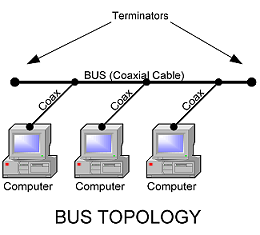 Networks employing a bus topology use a common physical connection for communication. That means the physical media is shared between stations. When one station transmits on the bus, all devices hear the transmission. If more than one device transmits at the same time, the two transmissions will collide with each other and both transmissions will destroy each other.
When two or more of these devices attempts to access the network bus at the same time, some method must be used to prevent a collision (CSMA/CD). Historically, bus networks used coaxial cable as their medium of transmission. Token Bus, Ethernet (Thinnet and Thicknet) are common examples of bus topologies. Although some installations of Ethernet using coaxial cable still exist, all modern installations now use a hub and spoke or star topology.
HUB AND SPOKE (STAR)
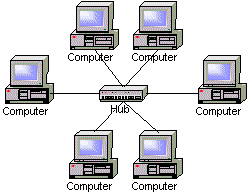
Please note that this is not called a hub and spoke design because there is a network hub in the drawing. This drawing is to show how a star or hub and spoke network resembles the hub and spokes of a wheel. The Hub and Spoke topology refers to a network topology where there is a central connection point to which multiple devices are connected.
A network hub device is not the only device usable in this configuration. A switch may also be used and in some cases, a router. Ethernet utilizing twisted pair still considered a bus architecture from a logical standpoint; however, physically, an Ethernet network can be physically wired as a hub and spoke model.
RING
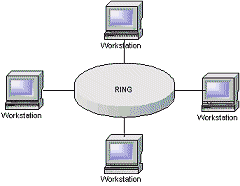
Ring topologies are similar to bus topologies, except they transmit in one direction only from station to station. Typically, a ring architecture will use separate physical ports and wires for transmit and receive, and more than one ring is usually used to enable bi-directional communication.
Token Ring is one example of a network technology that uses a ring topology.
POINT TO POINT (Daisy Chaining)
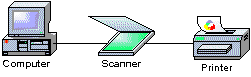
Point to Point topologies are simplest and most straightforward. You must picture them as a chain of devices and another name for this type of connectivity is called daisy chaining. Most computers can 'daisy chain' a series of serial devices from one of its serial ports. Networks of routers are often configured as point-to-point topologies.
POINT TO MULTIPOINT
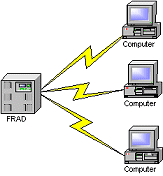
This is not quite the same as a hub and spoke configuration. In a hub and spoke topology, all transmissions from all devices pass through the hub--the hub broadcasts all communication from any single device to all other devices connected to it.
In a multipoint topology the hub can send to one or more systems based on an address. Frame Relay is the most common technology to implement this scheme, and it is typically used as a WAN technology. All the remote connection points are connected to a single Frame Relay switch or router port, and communication between sites is managed by that central point. In hub and spoke, all spokes or only one spoke hears a given transmission. In point to multipoint, any number of remote stations can be accessed.
<< Back to LAN Tutorials