- Central Offices Locations
- Cabling
- Digital Cross Connect Switch
- Time Division Multiplexors
- Exchanges
- NEBS and Telcordia (formerly Bellcore) specifications
- Electrical Power and Backup Power
Central Office (CO) Locations
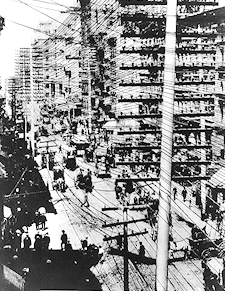
Early telephone systems started on the roof of the local central office and radiated outward in a spider web of connections between the central office, businesses and residential subscribers. To get everyone connected, the phone company sometimes created 'party lines' where multiple phones in different locations were on the same phone circuit. It was confusing to ring the phone and have several people pick up, so more cables were needed to connect everyone directly to the central office.
This led to a nightmare of cables strung all over the town and a tangled mess at the central office. Mother Nature eventually put an end to most of the telephone poles through blizzards, snowstorms, hurricanes and earthquakes. Today, nearly all telephone cables are underground. Underground, the cables are impervious to most wind and rain conditions, cannot be pulled down by ice or snow and are therefore more reliable. Most central offices also put out quite a bit of electromagnetic radiation which interferes with local radio and television signals. Central offices are now built underground to connect to the underground cables and to contain the electromagnetic radiation thrown off by the plant and to protect the equipment from weather and natural disasters. These facilities are built of concrete, rebar and steel. They are underground bunkers with redundant power, their own environmental systems and massive cable conduit pipes to bring in all the cabling from the entire area. These are all components in the new central offices and telephone operations centers.
So just what kinds of equipment would you expect to find in a central office?
 Cabling
LOTS and LOTS of copper cabling! Cables are everywhere in a central office. Thousands of cables from all over the geographic area will converge at the central office into huge cables. Each 'cable' contains multiple bundles. Each of the wire-bundles contains a set of 25 pairs of wires. The largest of these plastic-jacketed cables may have 600 or more pairs inside them. These cables are pulled through large underground pipes called 'conduit' into the central office. One of the capacity limitations of a central office is the conduit leading into the building. Once the conduit is full of cables, new conduit is needed. Once the cable exits the conduit, it is un-bundled, then laid into a cable raceway, split into individual pairs and those pairs are punched down into punch blocks mounted on a distribution frame.
These large cable-bundles all follow a color-coding scheme that technicians can use to properly identify individual pairs of wires so they can punch the correct wires down in pairs in the correct sequence--usually. Sometimes the pairs don't get punched down together and it has to be rewired when the technician comes to your house and can't get a dial tone. Sometimes the punched pair have very poor contact with the punch block resulting in degraded call quality or no dial tone. Sometimes the technician, annoyed at having to return to the CO to do a residential install, hurries and disturbs a different customer's line resulting in a second repair call.
Most of the time, once the wiring is punched down, it never needs to be touched and the connection is good for many, many years. Once upon a time, service was disconnected at the Central Office by removing the pairs. Today, it's done inside the electronic call-switching devices.
Distribution Frame (sometimes 'Main Distribution Frame')
The purpose of a distribution frame is to split up the local subscriber loop pairs in the cable bundle and connect them to other pairs already wired within the central office that lead to switching devices. The wiring inside the central office is often referred to as inside plant. As we described earlier, the copper subscriber loops providing local phone service are pulled in from outside the central office through huge conduits carrying hundreds of bundled copper pairs. These copper pairs are punched down on blocks on the subscriber or loop side of the distribution frame. The opposite side of the distribution frame is wired to digital cross connect switches inside the central office. This is how local subscriber loops are connected to the digital cross connect switches that actually connect the phone calls. The distribution frames are fusible which means they are designed to melt almost instantly and break the electrical connection and thereby provide one of many layers of surge protection for equipment inside the central office.
Digital Cross-Connect Switches
InetDaemon has heard these devices referred to variously as:
- DCCS - Digital Cross-Connect Switches
- DACS - Digital Access Cross-Connect
- DXS - Digital Cross Connect
- DSX - Digital Switching Cross connect (eg. DSX-1, DSX-3)
- Cross-Connects (which can mean different things to different repairmen..)
InetDaemon has heard most of the above acronyms pronounced dax. The function of these devices is to cross-connect subscriber lines and to switch calls between subscriber lines that are attached to the ditigal cross-connect switch, and to connect calls to other cross-connect switches. Digital cross connect switches perform the circuit switching functions that connect calls. Routing calls between exchanges or between providers or countries is handled separately.
Time Division Multiplexors
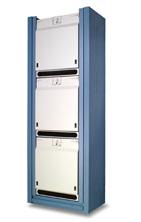 To carry voice calls between switches, individual voice lines are merged
using time-division
multiplexing. This merges the data from multiple voice channels into
a single higher-speed trunk lines between
switches and between exchanges. In the early
days of the deployment of trunk lines, the multiplexor was a separate stand-alone
device and multiplexing was
done in stages, from DS0's to DS1's and
then from DS1's to DS3's and
from DS3's into OC3, OC12, OC48,
OC192 and higher. All multiplexors are classified
by the level of multiplexing they can perform.
To carry voice calls between switches, individual voice lines are merged
using time-division
multiplexing. This merges the data from multiple voice channels into
a single higher-speed trunk lines between
switches and between exchanges. In the early
days of the deployment of trunk lines, the multiplexor was a separate stand-alone
device and multiplexing was
done in stages, from DS0's to DS1's and
then from DS1's to DS3's and
from DS3's into OC3, OC12, OC48,
OC192 and higher. All multiplexors are classified
by the level of multiplexing they can perform.
For example: an M1 multiplexor converts 24 DS0's to a DS1, the multiplexing level used over physical T1 facilities. An M12 multiplexor once existed as an intermediate step in multiplexing traffic from DS1 to the DS3 level. As technology advanced, multiplexing became more advanced and the devices became capable of multiplexing DS0's straight into DS3's. Multiplexing now occurs within the multiplexing device inside the digital cross-connect switch. Data from thousands of local subscriber loops are multiplexed into the largest trunk lines directly within the switch in one step. As technology continues to advance, even higher levels will be achieved.
Exchanges
Technically, each exchange consists of ten thousand local subscriber lines (xxx-0000 through xxx-9999) in a local geographic area that all run to a specific central office and one or more digital cross-connect switches within the office. The current system of exchanges was organized and built to support a geographically-based structure, but has had to adapt to the concepts of portable phone numbers and mobile phones. Each exchange within a central office is a set of one or more cross-connect switches that route your call based on the phone number you are dialing. The largest cross-connect switches actually handle several exchanges.
A United States phone number has a three digit area code, a three digit exchange and a four digit number for the subscriber. Usually, everything in your local geographic region will be part of the same local exchange which will have the same exchange number, but the advent of digital communications and explosive growth of mobile devices has forced changes to the North American Numbering Plan. For example, all the phone numbers in the 555 exchange will have 555-xxxx as their phone number. Today's central offices often serve more than one exchange. This is why you can often dial numbers that don't have the same exchange number and still only be making a local call.
Interesting Trivia: In the United States, the 555 exchange is reserved for special use by the phone company, such as the number for directory assistance (1-xxx-555-1212). The phone company (starting back when AT&T had a monopoly) actually set aside number-space for fictional use (555-0100 through 555-0199). This has been carried forward to present day and movies, books and television shows use the xxx-555-xxxx numbers. In older movies, phone numbers were given as KLondike5-xxxx. If you look at your telephone number pad, KL5 translates to 555.
The local exchange is the closest central office to your home. These offices handle phone calls within the exchange. From the perspective of a phone number, the exchange is the first three digits of your phone number after the area code. One or more local central offices will form a local calling area.
Foreign Exchange
A foreign exchange is any exchange outside your local calling area. It is connected to a local exchange via large, high-speed trunk lines that multiplex large numbers of calls onto a single common circuit. The foreign exchange used to be handled by your local telephone provider and was called the 'extended local calling area'.
National Exchange
The national exchange was the connection from the regional telephone providers to the long-distance telephone providers. This exchange is where your area code comes from.
International Exchange
Your long distance provider will connect to other long distance providers overseas. This is where country codes come in. For the United States, the country code is 01 (within the U.S. just dial '1'). A phone number within the United States looks like this:
STANDARDS: Telcordia/BELLCORE NEBS
Telcordia (formerly Bellcore) documents - NEBS
The Network Equipment Building Standards or NEBS (as defined by Telcordia) are the most widely known and used set of guidelines for the design of telecommunications and network data centers. These design criterion include guidelines for power consumption, power provisioning, radio interference tolerances and cooling (heat dissipation). Vendors wishing to sell equipment to telecom providers must be 'NEBS' compliant. This set of guidelines was developed in the early 70's to assist the Regional Bell Operating Carriers (RBOC) and system designers in designing standardized network equipment buildings that are safe, spacious enough to accommodate the equipment and the repairmen, and comply with environmental and federal safety standards. Additional requirements for special cases such as fires, flooding, earthquakes, tornadoes and lightning strikes are also taken into account. The documents also specify the operating characteristics of equipment vendors wished to sell to the RBOC's.
Guidelines for central offices were drawn up in the 1970's. These guidelines called NEBS (Network Equipment Building Systems) govern the design of a central office, assuring that safety considerations. An additional set of recommendations was developed by Bellcore, an organization funded by multiple Regional Bell Operating Carriers. All equipment designed to operate in a telephone central office are generally designed to meet both requirements.
NEBS Criteria
- Telcordia (formerly Bellcore) Generic Requirements GR-63-CORE covers the physical protection of equipment.
- Telcordia (formerly Bellcore) Generic Requirements GR-1089-CORE governs electromagnetic compatibility (EMC) and safety criteria
Electrical Power and Backup power
The telephone system is powered indirectly by the municipal power grid provided by the regional power company. Depending upon the size and design, two or more connections to the power grid are used. The phone company uses transformers to convert the electricity from the high voltage alternating current (AC) supplied by the power company to a lower voltage direct current (DC) used by the phone system equipment, typically 48 volts DC. The phone system and everything connected to it is powered by direct current (DC) that flows from massive lead-acid battery arrays fed by these redundant power connections from the local power grid. These batteries provide backup power and have the additional side effect of providing a limited amount of surge control and electrical line conditioning. Most central offices are also equipped with diesel generators and huge fuel tanks to keep the equipment running during an extended external power outage. When the generators fail, the batteries are the final source of power.
Your phone uses the electricity provided by the phone company over the phone line itself. This is why your phone keeps working even when the power is out and why we've all come to expect the dial tone to be there whenever we pick up the phone. The electrical power brought in to the central office is distributed throughout the central office via massive copper bus bars, heavy bolts and thick transfer wiring. Typically, -48 volts of direct current power is supplied to the majority of devices in the central office. The copper bus bars are charged with tens of thousands of volts of electricity and can fry a carelessly placed body part.
Many central offices appear from the outside to be too small to justify the massive HVAC systems and cooling towers attached to the buildings, but once you look underground, it's a whole different story.
- Batteries
- Charging batteries put out explosive hydrogen and/or hydrogen sulfide gas; batteries can leak corrosive sulfuric acid or explode when heated. Provisions are made to vent the gasses from charging and bags of absorbent material and barriers are used to keep the acid from spilling across the floor.
- Transformers
- A telephone central office consumes a large amount of electrical power. Stepping down power from the high external voltage level to the lower internal voltage level generates heat. This involves using transformers for this 'step down' process. Electrical transformers can overheat and occasionally explode; transfer relays produce sparks and other electrical fire hazards. Combine this with the explosive gas from charging batteries and you have a serious fire hazard to consider.
- Diesel Backup Power System
- The diesel fuel which presents it's own special threats of fire and explosions. The diesel motor produces carbon monoxide and other toxic gasses which must be properly vented as well.