The TCP three-way handshake in Transmission Control Protocol (also called the TCP-handshake; three message handshake and/or SYN-SYN-ACK) is the method used by TCP set up a TCP/IP connection over an Internet Protocol based network. TCP's three way handshaking technique is often referred to as "SYN-SYN-ACK" (or more accurately SYN, SYN-ACK, ACK) because there are three messages transmitted by TCP to negotiate and start a TCP session between two computers. The TCP handshaking mechanism is designed so that two computers attempting to communicate can negotiate the parameters of the network TCP socket connection before transmitting data such as SSH and HTTP web browser requests.
This 3-way handshake process is also designed so that both ends can initiate and negotiate separate TCP socket connections at the same time. Being able to negotiate multiple TCP socket connections in both directions at the same time allows a single physical network interface, such as ethernet, to be multiplexed to transfer multiple streams of TCP data simultaneously.
TCP 3-Way Handshake Diagram
Below is a (very) simplified diagram of the TCP 3-way handshake process. Have a look at the diagram on the right as you examine the list of events on the left.
| EVENT | DIAGRAM |
Host A sends a TCP SYNchronize packet to Host B Host B receives A's SYN Host B sends a SYNchronize-ACKnowledgement Host A receives B's SYN-ACK Host A sends ACKnowledge Host B receives ACK. |
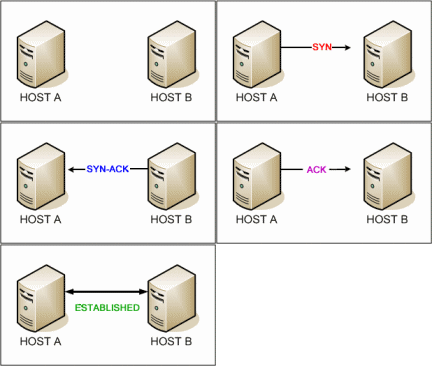 TCP Three Way Handshake (SYN,SYN-ACK,ACK) |
SYNchronize and ACKnowledge messages are indicated by a either the SYN bit, or the ACK bit inside the TCP header, and the SYN-ACK message has both the SYN and the ACK bits turned on (set to 1) in the TCP header.
TCP knows whether the network TCP socket connection is opening, synchronizing, established by using the SYNchronize and ACKnowledge messages when establishing a network TCP socket connection.
When the communication between two computers ends, another 3-way communication is performed to tear down the TCP socket connection. This setup and teardown of a TCP socket connection is part of what qualifies TCP a reliable protocol. TCP also acknowledges that data is successfully received and guarantees the data is reassenbled in the correct order.
Note that UDP is connectionless. That means UDP doesn't establish connections as TCP does, so UDP does not perform this 3-way handshake and for this reason, it is referred to as an unreliable protocol. That doesn't mean UDP can't transfer data, it just doesn't negotiate how the conneciton will work, UDP just transmits and hopes for the best.
Protocols Encapsulated in TCP
Note that FTP, Telnet, HTTP, HTTPS, SMTP, POP3, IMAP, SSH and any other protocol that rides over TCP also has a three way handshake performed as connection is opened. HTTP web requests, SMTP emails, FTP file transfers all manage the messages they each send. TCP handles the transmission of those messages.
TCP 'rides' on top of Internet Protocol (IP) in the protocol stack, which is why the combined pair of Internet protocols is called TCP/IP (TCP over IP). TCP segments are passed inside the payload section of the IP packets. IP handles IP addressing and routing and gets the packets from one place to another, but TCP manages the actual communication sockets between endpoints (computers at either end of the network or internet connection).
RELATED TUTORIALS
- More Tutorials about Transmission Control Protocol (TCP)
- More Tutorials about Internet Protocol (IP)
- More Tutorials about User Datagram Protocol (UDP)
TCP Tutorials
- Introduction to Transmission Control Protocol (TCP)
- TCP: A Reliable Protocol
- TCP Header
- TCP 3-Way Handshake
- TCP Connections
- TCP Sockets
- TCP Data Transfer
- TCP Segmentation and Reassembly
- TCP Flow Control
- TCP Multiplexing
- TCP Precedence
- TCP Transport Stream Push (TCP Push)